
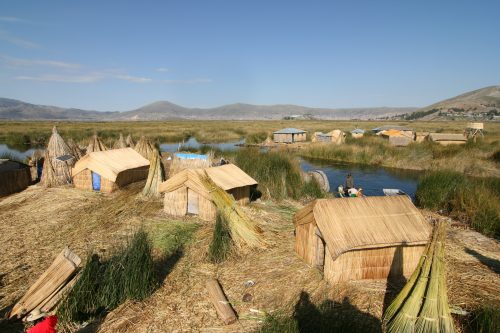
You wake up, oblivious to the gentle oscillations under the floor, and cross the reed mats to your tethered cormorant to see if it has caught a frog or catfish for your breakfast.
Grab a few eggs from the domesticated Ibis, pull up some totora roots from the lakebed, and start your omelet. The glare from early morning sun on Lake Titicaca is blinding so you re-enter your house, never noticing that it is dipping and rising a little more than usual today. Must be the wind across the small, floating island of some dozen houses you share with others of your tribe.
Of course, this is all taking place in the Peruvian Andes, 12,500 ft (3,800 m) above the ocean and sea level rise is not exactly a concern. But the Uru peoples’ floating homes can be instructive for those of us who dwell a little lower down.
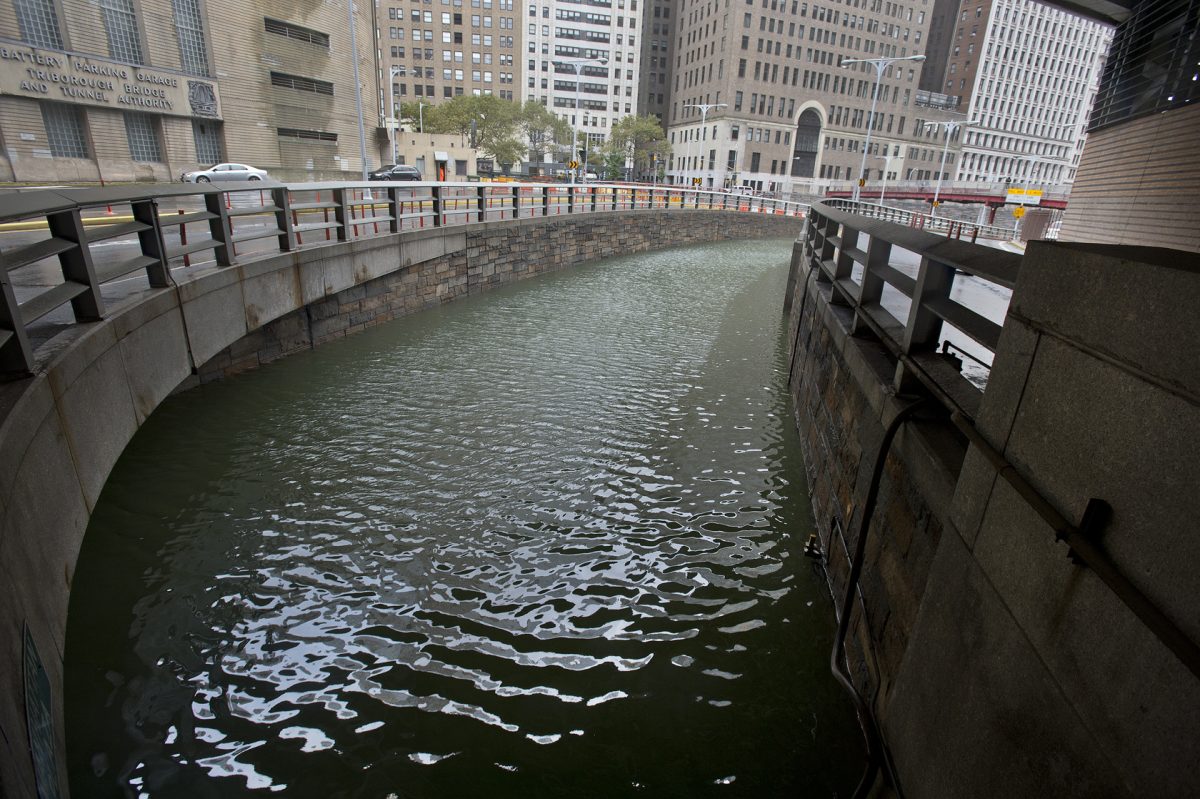
Manhattan entrance of the Brooklyn-Battery (Hugh L. Carey) tunnel, New York City flooded by
storm surge during Hurricane Sandy in October 2012. Photo by NYC Metropolitan Transit Authority.
Source: Wikimedia Commons
As we’ve been documenting, in the next few years, hundreds of millions of people are going to be permanently or periodically underwater unless we find creative solutions to hold back, manage, or adapt to higher sea levels. Managed retreat, forced relocation, call it what you will, whole societies will need to live differently. If it’s possible to find space inland or on higher ground, so be it. If not, well, adapting to the Uru model may be just the ticket.
The Uru drive Eucalyptus pilings into the lake bottom and build homes atop root-and-reed matts tethered to them, to form small floating islands, and they have been doing so for generations. These are not boats. They are floating homes.
The essential difference between the above and house ‘boats’ is permanence. Houseboats are simply mobile boats on which people live. Floating houses on the other hand are built in place or towed to their destination, designed to remain there either attached to floatable foundations or, as with the Uru, tethered to the lake, river, or seabed.
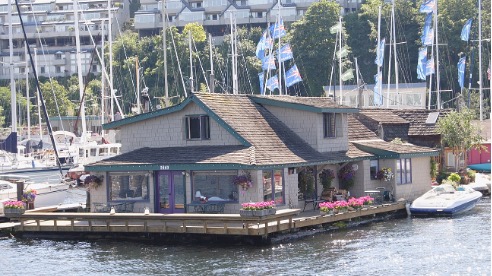
Floating house, made famous in the film Sleepless in Seattle (1993), Seattle, Washington.
Photo by Brian Teutsch. Source: Wikimedia Commons
With the air warming, seas rising, and storms surging, others around the globe who may never have heard of the Uru are floating their homes as well, with many more to come.
Indeed, adaptation to rising oceans is so urgent the magazine Science recently dedicated an entire issue to the matter in which they remark that “globally, sea level rise alone could place 340 million people on land projected to be below annual flood levels by 2050.” In other words, approximately the population of the United States will be displaced, and their communities permanently or periodically inundated, within the next 30 years.
It seems clear that floating homes must be a part of the solution: there are simply too many places where relocation is impractical or impossible.
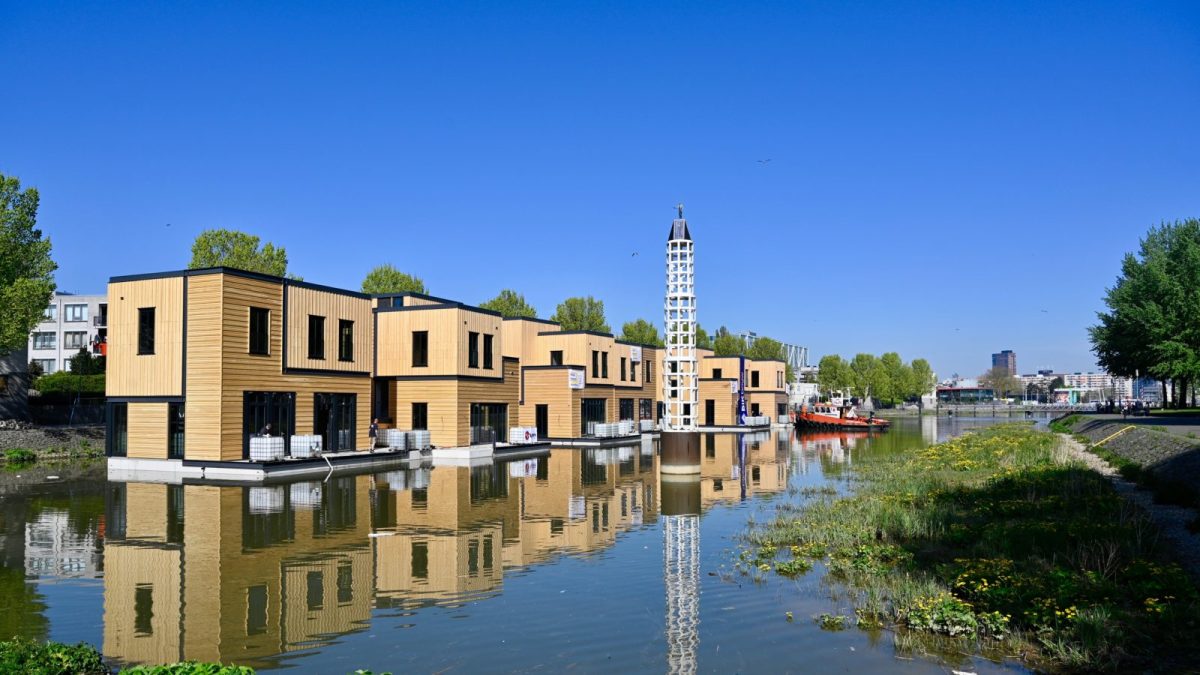
Floating homes in Nassau Harbor, Rotterdam, Netherlands
Holland, for example, now has floating communities on rivers in several towns including Amsterdam and Rotterdam, homes attached to anchored ‘moorings.’ Like the Urus’ homes these are not boats: they are permanently tethered to the bottom and fitted with all modern conveniences – no ibis omelets but plenty of heat, light, and plumbing.
The placid Rotterdam waterway in which these new homes are moored – the Nieuwe Maas – is nonetheless connected to the rough and intemperate North Sea at the nearby port. As such, these structures are subject to changing sea levels and bob up and down with the tides every six hours or so.
“The height difference between the extremes of the ebb and flow – high and low tide – ranges from one and a half to two metres in the Nassau harbour. This was taken into account… during the construction of the floating homes,” according to a Rotterdam newsletter.

Image by Janrye / Pixabay
This model is helpful for expanding a city, making use of previously unusable river and canal banks, and proofing homes against floods from rising baseline sea levels.
But what about areas where the full force of climate change – ever-more-frequent and violent storms, higher storm surges, inundation, and flash floods – hit the area? Places like the southern US coastline, the eastern coast of India, and Singapore where the land is just above current sea level, also may benefit from floating homes.

Photo by Bophomet Zhang / Unsplash
If communities expected to be submerged or chronically engulfed by storm surge are to survive, they will require homes that can withstand such conditions. Higher ground is, of course, the simplest option but not all communities have the will, resources, and land needed to move.
Many communities – consider the Florida Keys, the Maldives, the ports on the southern Mississippi, and nations like Bangladesh – are in flat areas where ‘higher ground’ does not exist.