

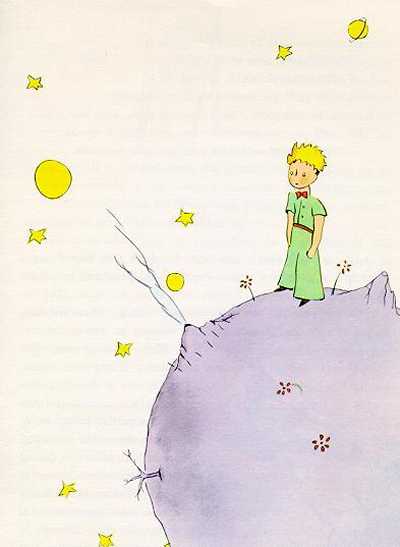
Antoine de Saint-Exupery, legendary pilot and author of such books as Night Flight and Flight to Arras (French: Pilote de guerre), wrote of his forced landing in a Saharan desert, and of his chance meeting with a Little Prince there among the dunes. It is to be hoped that we are not forced down so, for the land below us is as beautiful as the Sahara, yet even more forbidding.
Oh yes, I should have said that I am writing at just under 38,000 feet. My Boing777-200, an enormous craft build to hold hundreds comfortably, is more than two-thirds empty. Even as I luxuriate in all the space, I am aware of the paradox: sending a plane of these proportions on an intercontinental flight with 200-or-so open seats seems immoral. With no internet up here I can’t do the needed calculations and, of course, it’s rather too late to fret about it now.
Even so, it is charting a course from Washington, D.C., to Tokyo, some 6,800 miles over the pole as the frozen crows fly. We’ll get to the greenomics of such a flight later, but for right now, I’m captivated by the view below.
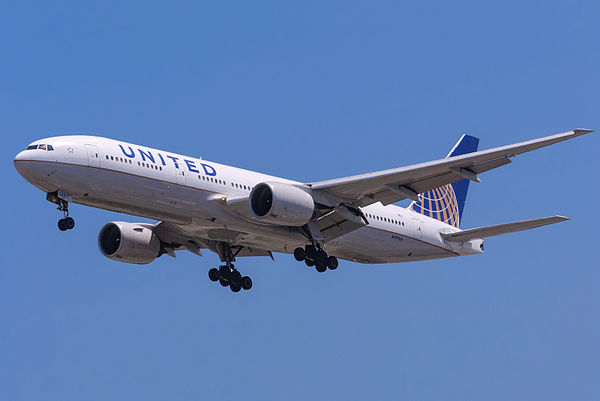
it can take off with an incredible 545,000 lb (247,200 kg). This may have been the very plane I flew in on this journey.
It is morning as we fly west across the Siberian hinterlands and I must be discreet, as all other window visors are tightly shut. The sun is in blinding contrast to the somberly dark cabin.
By the way, I must beg your indulgence for the quality of some of the photos. This was impromptu, and my phone just wasn’t up to the glare. My eyes were, though, and I feasted them on the sights.

From this height the horizon is about 240 miles away, and my Olympian view encompasses something like fifty-thousand square miles. All of it, all that I can see, is semi-frozen tundra. There are thousands of glistening pools, nestled in earth all of varied browns and tans. Some of these are actually large lakes, and there are river systems meandering through, threading the lands from west to east as we fly south-west towards Japan.
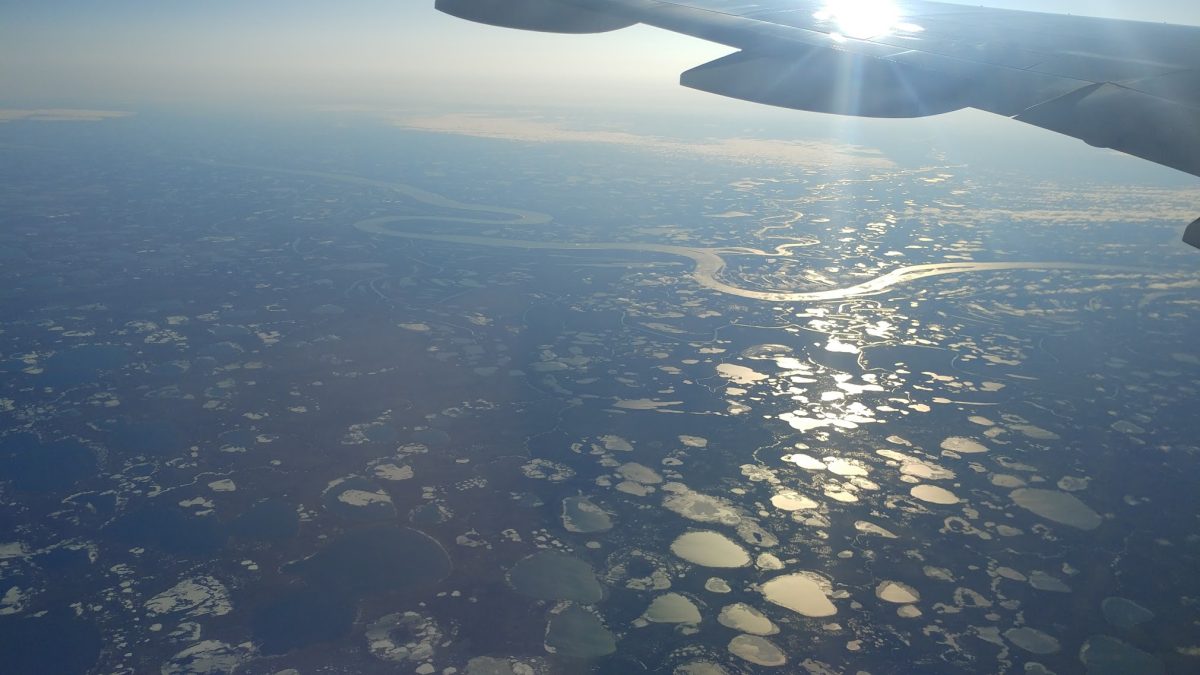
The largest of these I believe to be the Kolyma. It is tremendous, rivaling the world’s largest[1], with tributaries woven around it like veins around an artery. Ice dots the land here, sheets of it cover some of the pools yonder, all without hint of mankind. I see no cities, no towns, no roads or masonry, not a sign that a race which could build the massive plane I’m on exists or ever existed.
Since we sighted land from the East Siberian Sea it’s been the same view below. Thirteen hours over the pole to Asia makes it clear just how small the world really is. Then again, a landscape that goes on endlessly below suggests it’s still a vast and lonely place.

If water covers more than two-thirds of this planet, and lands like this cover so much of the rest, then mankind, for all our works, inhabits just a tiny fraction of it.
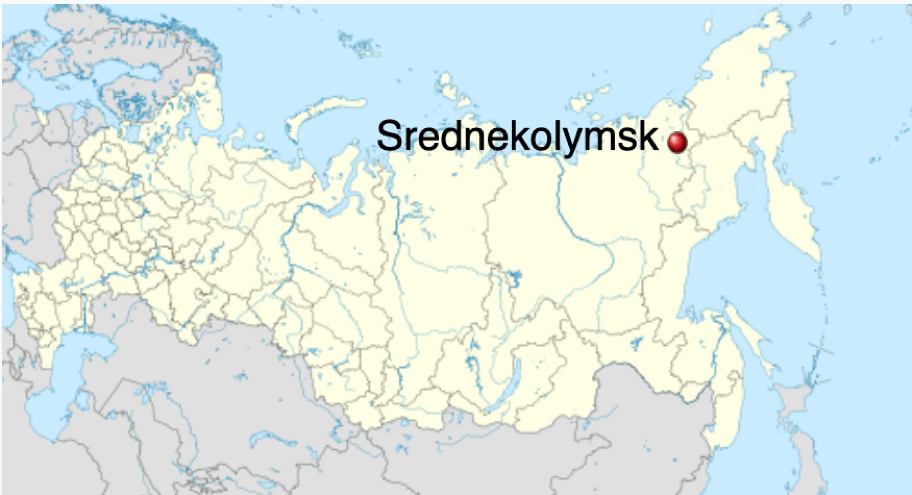
Yet as we fly over Srednekolymsk — a town of 3,525[2] lost in sudden cloud cover — en route to the mythical-sounding Sea of Okhotsk, I know that the lands below have already been dramatically and permanently altered by our hands. The very plane that has carried me safely this far — just under 4,000 miles — has burned, I calculate, about 90 tonnes of jet fuel — I read that even our wings are tanks — and we have more than 2,000 miles yet to go.

I don’t know whether the tundra here would have been completely frozen in years past at this time of year. But I do know the temperature / carbon equation has changed by our hand. I have written extensively on tundra for R.O.I., so I have an idea of the finely-honed knife-edge this landscape is on, and that the carbon it stores is being paroled far too quickly for us to manage.
In our last issue of R.O.I. we noted a report of a possible reprieve on this front: more warming in the tundra bringing more plants, for a possible short-term carbon sink. Looking from this height at the bleak lands below, devoid to my cloud-level eyes of any vegetation, that seems far-fetched.
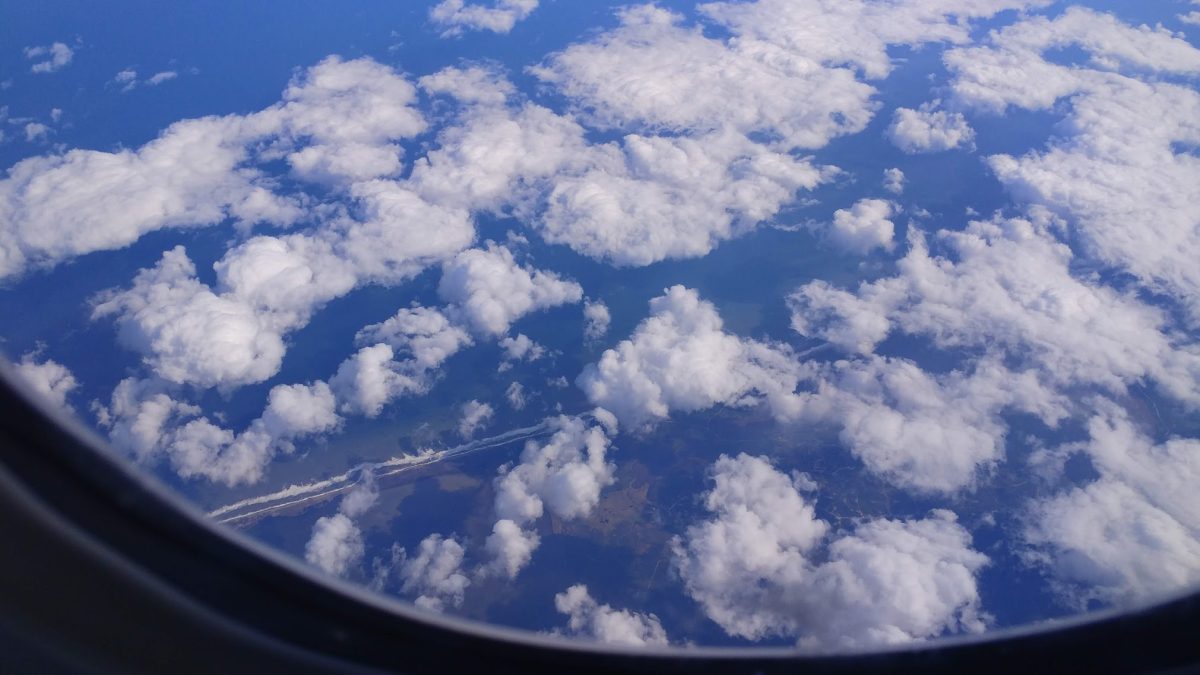
Clouds have engulfed us now and I am sad, for I’m yearning to see more of this rugged country. Wasteland. Hardly. I know there are billions of plants and animals below, fish, no doubt, in those pools, and this season there are grasses and gorse and wildflowers and I wish I could see them all.
Hopefully there are plenty of bees, though we know the pressure they are under everywhere. There should be millions of birds, though we learned this month that the United States, at least, lost a third of its birds over the past forty years. There are doubtless billions of mosquitos, too, swarming, buzzing, most of them seeking a meal they will never find.