
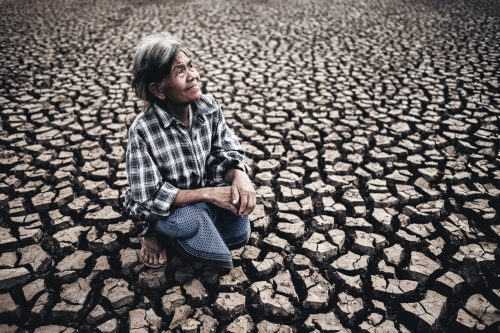
Photo by John Stocker
“Hi mom, hi dad. It’s us, the kids born in 2022, writing to you from 2095 when we are 73 – the global life expectancy when we arrived. Back then, you wondered which of the IPCC AR6’s long-term (2080-2100) climate scenarios had come to pass. Well, we can tell you now: it wasn’t the ‘very low’ emissions scenario – our generation had a good laugh over that one! Nor was it the ‘low,’ ‘medium,’ or ‘high emissions’ version. No, it turned out to be the IPCC’s worst-case: the hellish ‘very-high emissions, scenario’ for 2080-2100 (SSP5-8.5 in AR6 parlance, 1135 ppm CO2).[1] It’s not the zombie apocalypse, mom, but it’s bad.
“Why hellish? Well, that’s a long story, and we want you to know we don’t really blame you and our grandparents for… for… well, anyway, here’s what it’s like.
Sunblock, Anyone?
“Let’s begin with the obvious: it’s hot. We’ve hit the report’s best estimate of +3.5˚C (+6.39˚F)[2] over the period ending in 2014. Warm places like southern Florida, where you retired, your comfy 28°C (82°F) summers are now a balmy 31.5˚C (≈88˚F). Not so bad, you say?”

Photo by Modic / Unsplash
“Well, a global review from your era showed the “risk of mortality increased by between 1% and 3%” every time the thermometer rose by one degree C (in about half the locations studied). At +4.4˚C… well, you do the math. And we get nine or ten annual heat waves for every one you had[3], ramping temps as high as 6.6 °C on top of the baseline temps, lasting far longer, and more widespread than before. Arctic temps were already topping 38˚C (100˚F) when that report was written: just imagine where they are now. (Marine heat waves also rose, mom and dad.
“A 2008 study predicted that “days over 90 degrees in Chicago could reach as many as 80 in one year and the number of days over 100 degrees could be close to 30.” Chicago last had a 100˚ day back before we were born in 2012 (4x) and one projection suggested 2100 Chicago summers would most resemble those of Mesquite, Texas back when we were young. Mom, dad, they do.
Sorry to say our old house in Miami Beach flooded many times before it washed away. Back in 2021 the city demanded that all seawalls, public and private, be raised to a minimum 5’7” (1.73 m) above mean sea level. Under ‘very-high emissions though,’ that level rose between 0.98–3.88 m,[4] an astronomical 3.21 ft–6.17 ft. With or without a smidgeon of storm surge, that is well over mean and still rising. Buh-bye family beach house.”

Photo by Paul Sequeira. Source: Wikimedia Commons
Gimme a Polar Cocktail, Hold the Ice… Hold the Bears
“One cool thing: we cruised to the North Pole! With no late-summer ice in the Arctic Ocean anymore – no albedo effect need apply – we can sail right over it. True, the polar bears are all gone, but I guess you had to power your F150s somehow.
“Those who could have built homes in Greenland’s forests – yes, there are forests growing there now. The glaciers and permafrost are nearly gone. Even in your day, Greenland was melting fast and, to prepare, they were building green hydro-power plants and facilities to accommodate major population growth. Thank goodness someone was thinking ahead!”
“As we passed, the last remaining walruses in Baffin Bay were hauled up on shore. It’s likely they’ll be gone soon too, with no sea ice to rest and mate on. “Coming home, we sailed south but, I’m sorry to say, the coral reefs you used to snorkel in are gone, bleached, dead. I hate to tell you, but all the coral reefs have died: heated, acidified, and bleached by excessive CO2.”

Geirangerfjord, Norway. Photo by Maia Habegger / Unsplash
The Land “Of course, Greenland couldn’t take everyone – and wouldn’t if they could. Your progeny has spent their adult lives fleeing from one type of climate pressure or another, searching for a safe, stable home. Rising seas alone turned more than 2 billion of us into refugees but that’s not all. Remember when New York Magazine predicted that, though 1% of the world was just barely habitable due to high temps, that number would probably rise to about 17% when we grew up? Nailed it. We’ve been squeezed.
“Right around our first birthday, the U.N. reported that wildfires numbers were expected to increase by about 50% from the already prolific burns of the 2020s. Any walk in the northern summer woods is an invitation to get singed.”
Seeking: Higher, Firmer, Cooler, Safer, Calmer, Fertile, Fire-Free, Cyclone- and Drought-Proof Ground
“As you recall, the years up to 2016 saw the forcible displacement of some 6.5 million people for a variety of reasons but, “by 2060, about 1.4 billion people could be climate change refugees,” a 2017 paper predicted. Finding a new home wasn’t and just a matter of higher ground. As that same paper noted, Homes that weren’t either too hot, too wet, or too dry, subject to frequent powerful hurricanes, or in the paths of regular F4 tornadoes, have been hard to find. Dodging mudslides, heatwaves, and competition from multitudes also seeking a safe place, is tough.
