

In this space we’ve celebrated some wildly surprising innovations: electricity generated by bacteria; mollusks that reduce global warming; solar panels that gather energy at night or in the rain, and much more.
But rarely have the science guys astonished us so much as when we learned of their most recent project: making windows from wood.
No, no, not the frames, nor the sashes… the glass. They’ve done it using a transparent material that “has the potential to outperform glass…in nearly every way,” according to a U.S. Department of Agriculture blog.
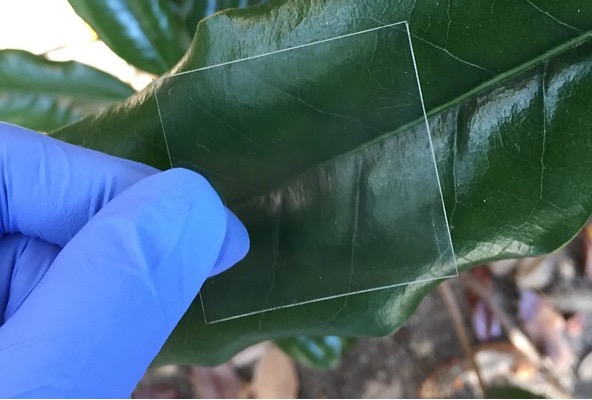
Wood glass. Photo by US Forest Service.
It is stronger than traditional glass. Less prone to shattering, too. Better at insulating. And nearly as transparent. Holy smokes!
A substance called lignin is largely responsible both for wood’s brown color and its opacity. Yet apply a little heat here, a pinch of vacuum there, a sprinkle of simple kitchen chemistry just so, et voila! Wood… with a view.
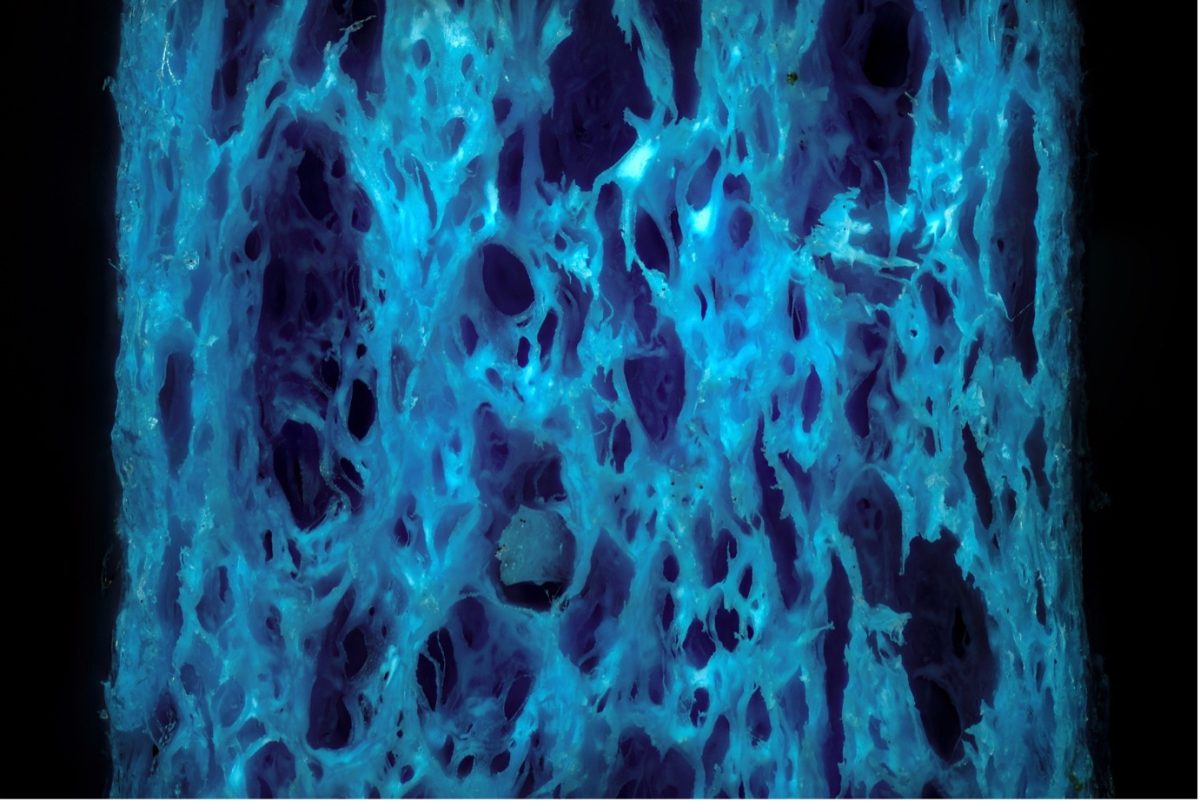
Microscopic image of a cellulose napkin. Photo by Alexander KIepnev. Source: Wikipedia
As noted by Indestructibles.com, wood is essentially composed of two materials: cellulose, “strong structural strings which are naturally clear,” and lignin, “a sort of opaque glue that holds all those strong cellulose fibers together.” Remove the opaque lignan, “replace it with clear epoxy,” and a strong, transparent glassine material will result.
While this process has been theoretically possible for some years – and a crude sample was actually produced in 1992 – the strength, durability, and ease of processing needed to make the resulting ‘glass’ practical were all wanting. Improvements were made in the past decade but hurdles remained. Then, early this year a team from the University of Maryland announced a method they called “solar assisted chemical brushing” that produces transparent wood material up to fifty-times stronger than earlier samples but requiring substantially fewer chemicals and less energy to make. An incredible 90% of light passes through, only about 6% greater absorption than standard glass.

Photo by Patrick Robert Doyle / Unsplash
Since wood is inherently regenerative, and because this material breaks down harmlessly in the environment – the chemicals used are relatively benign things like hydrogen peroxide – it could be the building material of the future for both load bearing and allowing light to pass through. Plate glass manufacturing contributes to atmospheric carbon both from the enormous heat needed to produce it and from “the decomposition of raw materials during the melting.” Wood composite, by comparison, is far less problematic.
The process of spinning wood into glass requires much less heat and the raw materials are not significant CO2 creators: both the source wood and the resulting windows are carbon sinks, sequestering CO2 for the life of the product and beyond.

Photo by Vyacheslav Makushin / Unsplash
For the first time, we actually can see the forest through the trees.