

Photo by Alexander Andrews
What happens when a company has more demand than capacity?
Well, they can raise prices or put customers on a waiting list, or they can raise money and invest in new facilities. But when a company is already running at maximum and then must tackle a broad sustainability agenda? That’s a problem, all right, and business is crying out for sustainability professionals to provide support and solutions – from vast global issues, to improving equality, to measuring total impact.
Then again, what would happen if the entire field of sustainability had more demand than supply? That is a problem too, and a big one. Sustainability pros themselves are crying out for better, faster, more portable solutions, and streamlined processes.
Fortunately, both issues can be addressed in large measure with an elegant four-part solution:
- Tools: Compressing work that formerly took weeks or months into days or hours greatly increases capacity. A quiver full of blazing fast sustainability tools allows a few people to manage the work of many
- Metrics & Data: Managing better requires measuring better, which means better information – especially strategic information – cuts time and effort while improving results
- Catalytics: Creating impacts far beyond any set of 4 walls, so a smaller use of resources brings results to a larger swath of the global community
- Valuation: there is enormous value available from sustainability – not simply intangibles but actual bottom-line ROI. Once quantification makes that value palpable, it’s as clear as lines on a balance sheet that creating more capacity is a worthwhile investment
Valutus has been focused on offerings in these three areas for years because we have always believed the eventual increased demand for sustainability would prove to be exponential. The only way to meet it is with methods that seem small but pack an enormous wallop. The biblical King David could not beat the giant with swords or fists but found a tool that could have powerful and immediate impact from a distance. We in sustainability, facing our own Goliath-sized challenge, must do so also.

Tools
Whether it’s risk identification or formulating science-based targets, tools that make complex tasks simple, blazingly fast, and inexpensive can nullify the need for extra capacity. Some of the issues crying out for tools to add capacity are:
- Materiality, which consumes significant time and resources every two years – and rarely produces value to match. However, it can be streamlined into a fast-clock-speed process that integrates trend research, an early warning system for over-horizon issues, finger-on-pulse analysis of stakeholder expectations, and next-gen 4D Materiality™. Combined, these comprise what Valutus calls Stakeholder Science™ – which renders more powerful answers more frequently
- Science-based carbon targets typically require 3-6 months to set, taking precious time and resources away from actually meeting them. That is an unnecessary waste of capacity: the process should take a few days at most and the right tool – the Valutus Carbon Target Tool, for example – enables just that. The Target tool also reports on progress, visualizes remaining shortfalls, and updates key stakeholders every year. This process, which usually takes a couple of weeks, can be done in a few hours instead – freeing up yet more capacity
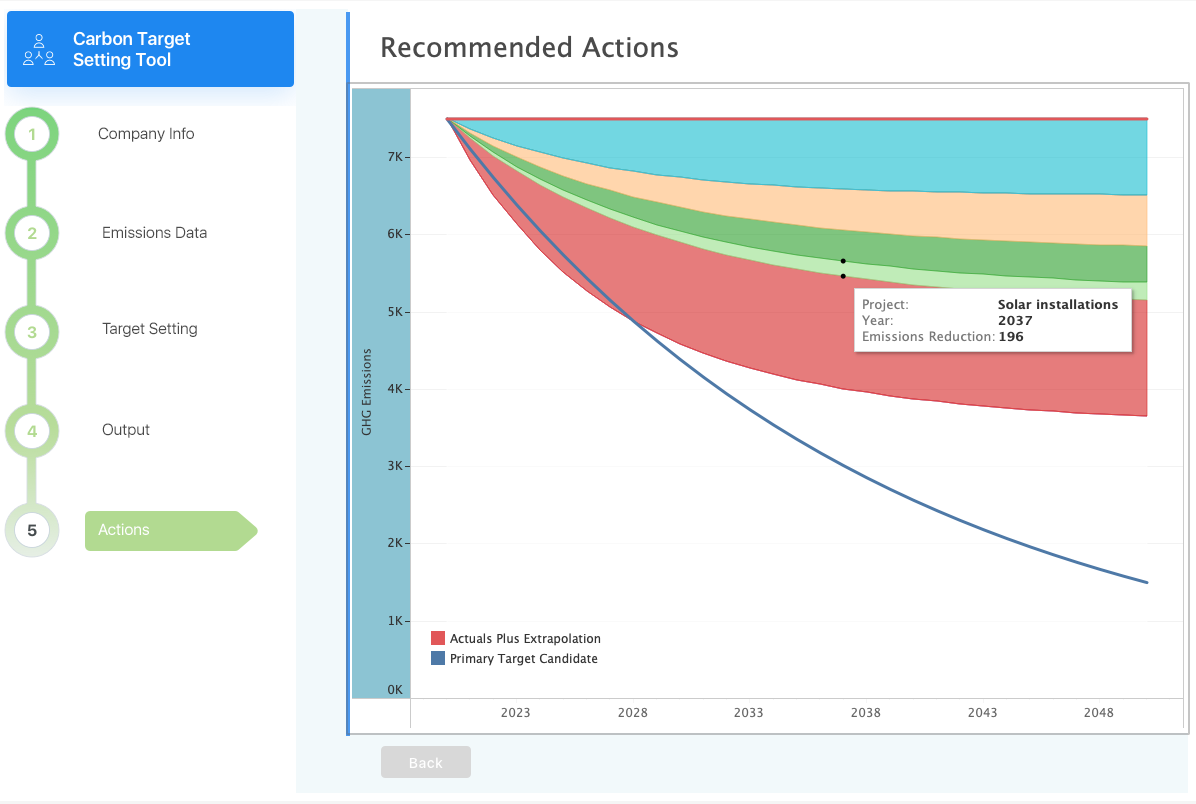
Screenshot of CT Viz™ Carbon Target Tool
Metrics & Data
Most businesses understand the business adage that says, “if you can’t measure it, you can’t manage it.” As a result, a lot of time and effort goes into measurement and data collection, which means it’s ripe for capacity-elevating action.
Better, more actionable measures are a good place to start. A corollary to the truism above is that if you measure something poorly, you manage it badly.
Unfortunately, a lot of business efforts suffer from poor measures, which either leads to lower-quality results or a great deal more required investment than should be the case. This is especially the case for areas that are complex or that have only recently come into focus – and even more so when both conditions are true.
Valutus has tackled this issue in specific areas ranging from plastic waste to gender and racial equity to measuring a company’s true total impact on the world.

Another capacity expansion candidate is getting the right data, especially strategic information.
Operational, accounting, and ERP systems can provide good tactical data, which is why Valutus doesn’t tinker in those areas – our philosophy is not to reinvent any wheels that already work well. Good strategic data, on the other hand, is much harder to come by.
Companies and investors find themselves with questions they can’t answer about where the world is going and what those changes mean for them. That’s why we’re building out a suite of data products that both provide better answers and free up resources for acting on the data rather than collecting it. As the clock speed of change continues to increase, raising the importance of strategic information and the investment required to keep it up to date, unchaining extra capacity for action is critical.
Two early entrants in our growing portfolio are the E3 Evolution™ (E3E) service and the VIEWS™ early warning system. Both are included in Stakeholder Science (described further in the next article) and are also available individually.
E3E tracks the evolution of issues from Exceptional to Established to Expected.
- Exceptional: items such as plastic neutrality, to which only a handful of companies have so far committed, transforming over time into…
- Established: for example, SBTs, which, despite being well established, still have only a few companies signed on, becoming…
- Expected: for instance, publishing a sustainability or CSR report, which is now basically universal among the largest companies

E3Evolution™ Display of Issue Categories & Momentum . You can see the growth and leveling off in the Environment category (dark green) and DEI (dark blue). You can also see patterns in when companies communicate around these issues, especially around July, December, and April.
(Note: There is also a more detailed issue-level view – e.g., capturing momentum “Climate” instead of “Environment” overall.)
The Valutus Issues Early Warning System (VIEWS) looks over the horizon to see what’s coming, giving you time to prepare rather than simply reacting. Given that an ounce of prevention really is worth a pound of cure, you might expect that better foresight would pay off by reducing the amount of investment needed compared to being surprised. And you’d be right: for one company, we discovered that even six additional months of foresight reduced the cost of adapting by 80%.
Catalytics
From the