
By Dan Kempner, Managing Editor, Valutus Sustainability R.O.I.
As a teenager, circa 1975 or so, I visited friends on Cape Cod just as moon and bay hosted the longest neap tide of the year. Launch your dinghy on the Brewster Flats, row frantically ‘til the receding tide overtakes you, and walk the tidepools on the endless sandbar another half mile to the clamming grounds. The basin’s sands are pristine and glistening.

Crabs and other scuttling creatures nip and run, the scent is the ineffable pungence of exposed and fermented sea bottom. Dig, dig, dig for an hour or two, then race back to the boat with your swag before the fast-returning tide overwhelms you. Haul up at last on warm sand decorated with shells and seaweed. What a great day!

The Vietnam War ended that year and, as time has passed in its steady fashion, I’ve circled away from those shores, having made a new life as an Expat American in Ho Chi Minh City, the former Saigon.
This weekend my own little family visited the local equivalent of Cape Cod, a town called Phước Hải near the peninsular shorefront city of Vũng Tàu.

The plastic trash was not limited to the beach. (She contributed the spoon, which we picked up and washed). Photo by Dan Kempner
On arriving, I eagerly took my 4-year-old hunting for shells among the fishing craft lining the beach. At the seawall steps, however, for the first time, I came face-to-face with a reality I’d only read about before.

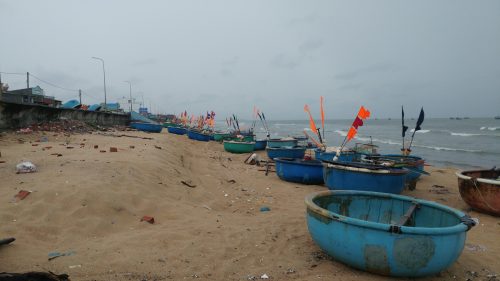
Pictures and accounts had not adequately prepared me for what I saw. Some hundred yards away the East Sea roiled uneasily at low tide. In between, another ocean—a tattered sea of plastic trash—lay washed up, blown, buried and fluttering in the sand at our feet.

Boats of unusual design—round tubs housing acres of nylon-mesh netting—were hauled up on the beach. They’re oddly picturesque, but all made of battered, blue plastic.


Originally, such boats were of plaited bamboo with bamboo oars and poles. Now the oars, the nets — once plant fiber — the fish boxes once of wood, and the lunch bags are all plastic too. It’s monsoon season and plastic’s the ideal material to keep things dry in an open dinghy.

Kailin, unperturbed by the shambles, kicked off her flip-flops and set out after shells. There are some truly unusual corkscrews here which I have not seen elsewhere, a sea snail my wife tells me.

It was a smorgasbord to Kailin, who was just as happy to pick up a brightly colored bottle cap as a mussel shell, but I was heartsick.
I have skinny dipped the post-hurricane rollers on a moonlit night off Montauk. Body surfed Santa Barbara’s swells. Braved frigid sands off Mount Desert Island. Spent a romantic week in a Bedouin hut on the dunes of Dahab along the Red Sea coast.
I’ve popped seaweed pods in the rocky estuaries of Vancouver Island, walked beneath the curls of Lake Michigan’s frozen waves, and trolled beaches up and down America’s east coast.